
Mindless Snacking
Here's a number that stopped me in my tracks when I first read it.
The average person consumes an extra 300 to 500 calories every single day — without knowing it. That's not from meals. That's not from snacks they planned. That's from the eating they did on autopilot. The bites, the tastes, the "just a little bit." The food that happened without a decision being made.
300 to 500 calories a day. Do the maths. That's the equivalent of gaining an extra 15 to 20 kilograms a year — just from the eating you weren't paying attention to.
Just have a think about what that means. You could shave off 300 – 500 calories a day just by being more mindful about when you’re eating. Or by stopping to “eat by mistake”
We spend so much energy thinking about what we eat — reading labels, choosing salads over chips, cutting out carbs — and yet research tells us that the eating we're not even aware of could be doing more damage than any of our conscious food choices.
I'm Cherine Chinnock, and this is Habit #3 in the 10 Worst Habits for Your Health series. Today we're talking about mindless snacking. Not the snacking you plan — the snacking you don't even realise you're doing. What it's actually costing you, why your brain is almost wired for it, and the simple shifts that break the cycle — without dieting, without restriction, and without white-knuckling it on willpower.
So What is mindless snacking?
Mindless snacking is eating that happens outside of conscious awareness. Not driven by hunger, not driven by choice — driven by cue, habit, and environment.
Food psychologist Brian Wansink found that people make over 200 food decisions per day — and are only aware of about 15 of them. Let me say that again. Two hundred food decisions. Fifteen conscious ones. I mean that’s good news right! Clearly it’s not a willpower problem. That's an awareness problem. That’s the good news.
The bad news is that beyond the calories — mindless snacking disconnects you from your hunger signals. When you eat constantly in response to environmental cues rather than genuine hunger, your body's ability to read its own signals starts to deteriorate. You lose touch with what actual hunger feels like. You lose touch with what full feels like. And that drives overeating, poor food choices, and a very complicated relationship with food.
As with most of these sort of habits, this is not entirely your fault. Our environment has been engineered to make mindless snacking almost inevitable. Just look around you! Unlike 10 years ago. today sweet treats are available everywhere! You are literally never more than 5 minutes away from a tasty sweet treat. No longer is this the domain of grocery stores and cafes, today you are relentlessly triggered with snack options everywhere: pharmacies, news agents our the local post office – even just walking down the street! Its impossible to avoid.
And then we have Ultra-processed foods - designed to hit what food scientists call the "bliss point" — the precise combination of salt, sugar, and fat that triggers maximum dopamine release and bypasses your satiety signals. So foods that taste amazing and don’t trigger your off switch. Have you ever stopped to consider why you couldn’t possibly drink a cup of pure oil – but that’s the same amount of oil in a large pizza or double cheese burger. These foods are literally designed to make you eat more than you intended.
Then there's your environment. The more visible and accessible food is, the more we eat — regardless of hunger. Your brain sees food, registers a reward opportunity, and sends the signal: eat. Even if you're not hungry.
And the deepest layer: emotional eating. Most mindless snacking isn't about food at all. It's about emotion regulation. Stress. Boredom. Loneliness. Fatigue. We reach for food because it delivers fast, reliable comfort. Carbs trigger serotonin. Sugar triggers dopamine. Your brain learns: feel bad → eat → feel better. And the more automatic it becomes, the less aware you are that it's happening.
But I’m sure you already know all of this. The question is how do we STOP! Not with a diet. Not with willpower. Willpower fades and is no match for the power of our environmental triggers and psychological cues. We need to tackle this in a different way. With something that’s actually going to work! We’re going to change our habits by addressing the TWO most important factors 1) awareness and 2) environment design.
With this in mind, I’ve created a simple 5 step plan called “SPACE”
S — Stop and ask: am I actually hungry?
P — Plate it — sit down, no screens
A — Arrange your environment to work for you
C — Check your emotions before you eat
E — Eat deliberately — planned, portioned, real food
Step 1: Before you eat anything outside a meal — pause. Ask: am I actually hungry? What am I feeling? You might still eat. But you'll choose it consciously. That changes everything.
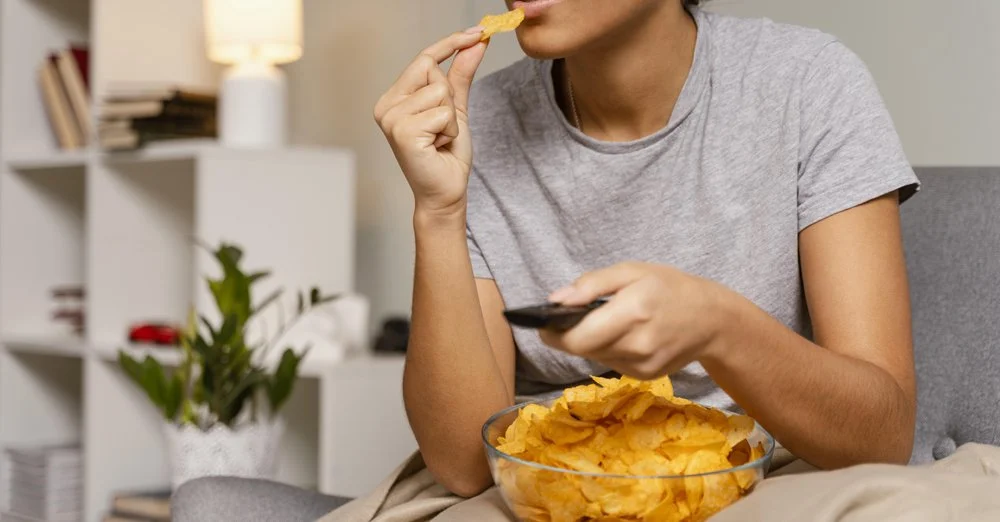
Step 2: Create eating occasions, not grazing habits. Sit down. Put food on a plate. Eat without a screen. Research shows eating in front of the TV means you eat more and feel less satisfied.
Step 3: Redesign your environment. Move unhealthy snacks out of sight. Store them in cupboards, not on the bench. Pre-prepare healthy snacks and keep them visible. You cant reach for healthy snacks that aren’t there. What's accessible is what gets eaten — make your environment do the work.
Step 4: Identify your emotional triggers. Notice what's happening when you reach for food outside mealtimes. Name the emotion. Then address it directly — not through food.
Step 5: If you snack, snack deliberately. Choose snacks with protein and fibre — nuts and fruit, Greek yoghurt, hummus and veg. Real food. Planned. Portioned. Sitting down.
The goal is awareness. You cannot change a behaviour you cannot see.
Tonight — I want you to "Give your eating habits some SPACE."
When you feel the urge to reach for something outside a meal — pause. Five seconds. Ask: am I hungry? What am I feeling?
That five seconds is where change begins.
Drop it in the comments: what's your biggest mindless snacking trigger? Stress? Boredom? TV time? Late nights? I read every one.
Subscribe for the rest of the series — 7 more habits to go. Share this with someone who needs to hear it. See you in the next one.